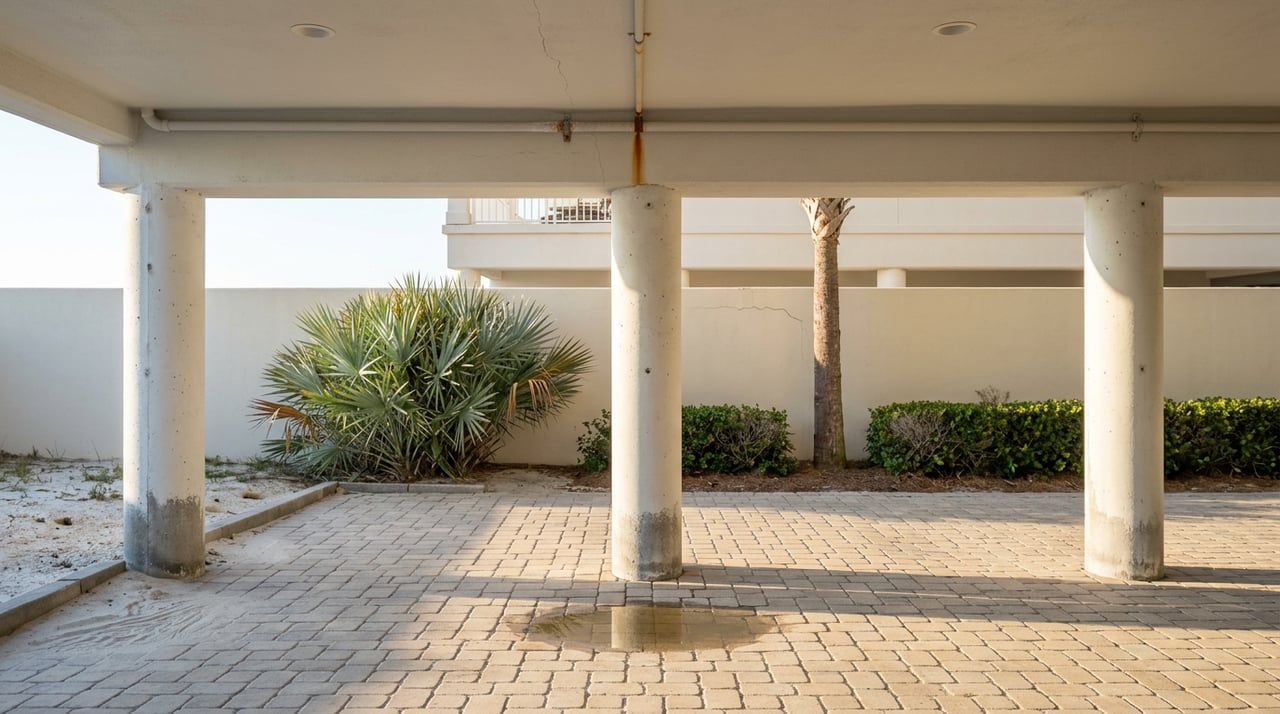
How Hurricane Insurance Freezes Delay Gulf Shores Closings
August 13, 2026
At 10:00 p.m. on July 24, 2026, the Alabama Insurance Underwriting Association lifted a set of application restrictions it had imposed because of Named Storm Bertha. Whatever Bertha ultimately did to the coastline, the freeze itself was the real event for anyone trying to close on a coastal Alabama property that week. For as long as the restriction stood, nobody could bind new wind coverage in the pool's territory, whether that property was a detached home on Ono Island or a condo unit whose buyer needed a fresh insurance binder to satisfy a lender.
That's the part of a Gulf Shores condo purchase nobody puts on a closing checklist. Buyers price out the unit, the HOA dues, maybe a special assessment. They don't price out the fact that during the six months a year when they're most likely to be shopping, the state's insurer of last resort can simply stop accepting new business the moment a tropical wave earns a name.
The Alabama Insurance Underwriting Association, known locally as the Beach Pool or the Wind Pool, exists because private insurers routinely decline to write windstorm coverage in coastal Baldwin and Mobile counties. The Alabama Department of Insurance says every property insurer doing business in Alabama has to participate in the pool unless it already writes a disproportionate share of coastal business, which is why the AIUA touches almost every transaction along this coast even when a buyer never sees its name on a policy.
The tradeoff for being the market's backstop is that the AIUA has to manage its own exposure. When a system approaches the coverage territory, new applications get suspended so the pool isn't taking on fresh risk seconds before a storm arrives. That's exactly what happened with Bertha. The restriction wasn't a one-off. It's the normal operating procedure for a wind pool, and it will happen again this season.
For a condo buyer, the practical risk shows up at the financing stage. A lender's insurance requirement has to be satisfied before closing. If your building's master policy relies on the AIUA for wind coverage, or if you personally need a new binder for a detached home, and a storm forms during your option period or the week before closing, you can find yourself waiting on a government-adjacent underwriting freeze instead of your lender.
Part of why this catches buyers off guard is that Gulf Coast property insurance isn't one product. It's three, and each one has its own market and its own timeline.
| Layer | What it covers | Typical annual cost |
|---|---|---|
| HO-6 (condo owner's policy) | Interior finishes, personal property, liability, loss assessment coverage | Roughly $480 to $900 statewide, $650 to $1,100 for Gulf Coast units specifically, depending on the source and coverage level |
| AIUA wind coverage | Windstorm and hail damage when a private insurer has excluded wind, either for the association's master policy or an individual property | Varies by building and construction; part of a combined coastal protection cost |
| Flood insurance | Storm surge and flood damage, excluded from both HO-6 and most wind policies | Around $2,051 a year for an AE flood zone under NFIP's Risk Rating 2.0 |
Layered together, homeowners across Baldwin and Mobile counties typically land somewhere between $2,000 and $6,500 a year for complete coastal protection, depending on construction, value, and how much of that risk the private market is willing to take versus how much falls to the AIUA. That range is the real number a buyer should be running against their monthly budget, not the HO-6 quote alone.
Here's where price-per-square-foot comparisons start to lie to buyers. Two units in two different buildings can list for the same price and still carry meaningfully different insurance costs, because the building's own master policy determines how much of the interior a buyer's HO-6 has to cover.
Older Gulf Coast buildings often carry what's called a bare walls-in master policy. That structure insures the building's shell and stops at the studs, which means the unit owner's HO-6 has to cover everything inward: drywall, flooring, cabinetry, fixtures, and any built-ins. Other associations carry an all-in, or single-entity, policy that covers original fixtures, leaving the owner responsible mainly for upgrades and personal property.
Neither structure is better across the board. But a buyer who doesn't know which one they're getting is pricing their insurance blind. Before writing an offer, it's worth pulling:
If there's a lever that reliably changes the math, it's FORTIFIED Home certification. According to Local Property Inc., Alabama insurers are legally required to offer a discount for homes built or retrofitted to the FORTIFIED standard, and depending on the tier, Bronze, Silver, or Gold, owners typically see a 20 to 50 percent reduction on the wind portion of their premium. That's not a marketing claim. It's grounded in what happened during Hurricane Sally in 2020, when homes built or retrofitted to FORTIFIED standards suffered measurably less damage than conventionally built properties, which is part of why the discount exists in state regulation at all.
The certification isn't permanent. Roofs need recertification roughly every five years to keep the discount active, so a FORTIFIED tag on an older listing is worth verifying rather than assuming still applies.
Buyers reading condo documents tend to scan for one thing: is there a special assessment for a repair. That's the right instinct, but it misses a second category. Some associations pass along insurance costs as a separate line item rather than folding them into monthly dues, which means an assessment notice in the file might have nothing to do with a leaking roof or aging balconies. It might simply be the association passing along a premium increase from its own carrier.
Both types of assessment affect a buyer's real cost of ownership. Only one of them tells you anything about the physical condition of the building. Ask the association directly which category any current or recent assessment falls into before assuming the worst, or the best, about what it means.
For anyone shopping a Gulf Shores condo between now and the end of November, timing the insurance piece matters as much as timing the offer itself.
If you're listing a Gulf Shores condo during hurricane season, the same freeze that can stall a buyer's closing can also stall your sale, even if your own coverage is already in place. A buyer whose financing depends on a fresh binder is exposed to the same restriction you aren't. It's worth having your master policy declarations, current deductible structure, and any FORTIFIED documentation ready to hand over the moment an offer comes in, so your buyer's insurance shopping doesn't add avoidable days to a deal that's otherwise ready to close.
Does every Gulf Shores condo buyer need their own AIUA policy? No. Most condo wind coverage is handled through the association's master policy. Individual buyers are more likely to need their own AIUA policy if they're purchasing a detached home or if their unit requires a separate endorsement for improvements the master policy doesn't cover.
How would I know if a storm-related freeze is affecting my closing? Ask your lender or insurance agent directly whether the binder they need is coming from a carrier subject to AIUA restrictions. The AIUA posts current application status on its own site, and any agent writing AIUA business can check it in real time.
Is a bare walls-in master policy a red flag? Not by itself. It's common in older Gulf Coast buildings and simply means your HO-6 needs to do more work. The red flag is not knowing which structure your building uses before you budget for coverage.
Does FORTIFIED certification transfer to a new owner? The physical construction does, but the discount depends on the certification staying current. Confirm the recertification date rather than assuming a past FORTIFIED label still qualifies for the discount today.
If you're weighing a Gulf Shores condo purchase or sale and want someone who's underwritten mortgages, owned rental units, and closed deals through more than one hurricane season, Vince Burchfield can walk you through what a specific building's insurance stack actually looks like before you write an offer. Let's Connect.
This article is general information, not legal, tax or financial advice. Consult a qualified professional about your situation.
Stay up to date on the latest real estate trends.
Get assistance in determining current property value, crafting a competitive offer, writing and negotiating a contract, and much more. Contact me today to discuss all your real estate needs!